
BrandOps Consultancy
BrandOps Consultancy


Most companies diagnose brand drift too late. They notice it when the website feels disconnected from the sales deck, when campaigns no longer sound like they came from the same business, or when customers can’t quite explain what the brand stands for anymore.
By that point, the damage is already moving through the system. Brand drift rarely appears as one sudden failure, because it spreads through small deviations that seem harmless at the time, then travels across teams, channels, assets, audiences and eventually commercial value.
A sales deck doesn’t quite follow the new positioning. A regional team adapts the messaging to suit a local market. A campaign launches with a slightly different interpretation of the brand. Each decision may be sensible on its own, but together they create a pattern that slowly pulls the brand away from its intended position.
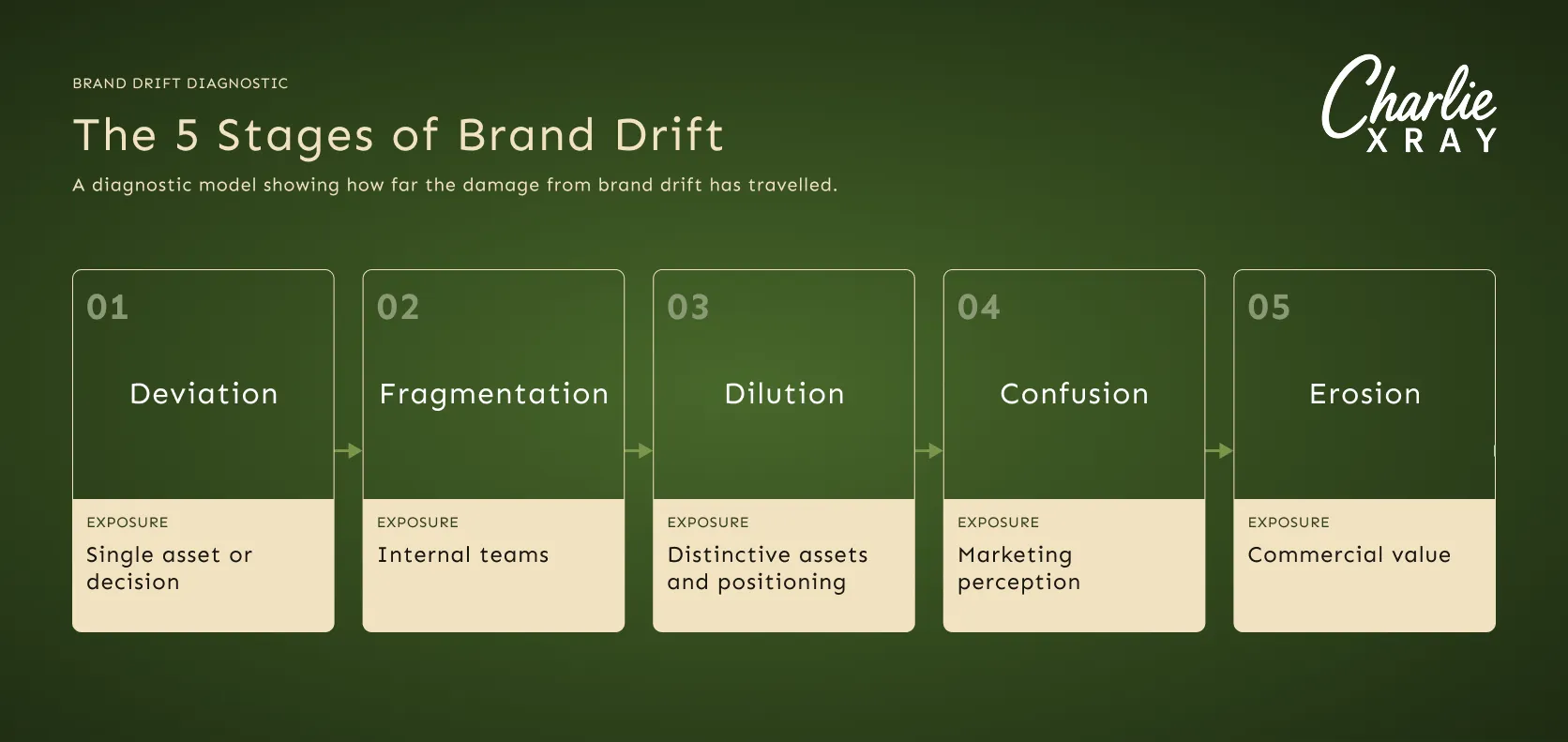
We developed the 5 Stages of Brand Drift as a practical diagnostic model for understanding how brand alignment deteriorates over time. It gives brand, marketing and leadership teams a clearer way to identify where drift is happening, how far the damage has travelled and what kind of intervention is needed before the problem becomes expensive.
The model draws on established thinking in brand equity, internal branding, distinctive assets and organisational alignment. It is also grounded in a practical reality that most brand leaders know too well: strategy doesn’t fail only because the thinking is weak. It often fails because the organisation has no reliable operating system for keeping that strategy alive once the launch deck is closed, the agency is gone and everyone goes back to moving fast.
Brand drift is the gradual loss of alignment between what a brand is intended to represent and how it actually shows up across the organisation.
It can affect positioning, messaging, visual identity, customer experience, employee behaviour and commercial decision-making. That matters because brand drift is rarely just a surface-level consistency issue, even when the first visible symptom is a messy asset, an old deck or a piece of content that feels slightly off.
Many people treat brand drift as a visual consistency issue. That is part of it, but it is not the whole problem. A wrong colour, an old logo or an inconsistent template might be the first visible symptom, but the root issue is usually deeper.
Brand drift happens when the organisation becomes more complex than the brand systems holding it together. Growth, new hires, multiple agencies, new markets, decentralised teams, acquisitions, AI content tools and post-rebrand fatigue can all increase the distance between the brand as defined and the brand as delivered.
This is why brand drift is often missed. It doesn’t look like a crisis at first. It looks like people adapting, moving quickly and getting work out the door.
Brands create value through repeated, recognisable and meaningful signals. When those signals become inconsistent, the brand becomes harder to recognise, harder to remember and harder to trust.
Kevin Lane Keller’s customer-based brand equity model argues that brand equity depends on brand knowledge in the minds of customers. That knowledge includes awareness and brand image, which are built through the associations people form over time.
David Aaker’s brand equity model also reinforces the commercial importance of awareness, associations, perceived quality and loyalty. These are not decorative brand concepts. They are assets that help businesses create preference, reduce risk, support pricing and improve efficiency.
The Ehrenberg-Bass Institute’s work on distinctive brand assets adds another useful layer. Distinctive assets help people recognise and recall brands in buying situations, which means consistency is not just about neatness. It is about protecting the cues that make the brand easier to identify and remember.
This is where brand drift becomes commercially dangerous. What starts as a minor execution issue can become a wider alignment problem, and once that damage reaches customers, perception and commercial performance, it becomes much harder to contain. The point is not that every inconsistency is catastrophic. The point is that organisations need to know when a small slip has stopped being small.
The 5 Stages of Brand Drift describe zones of exposure rather than a strict sequence of cause and effect. A brand does not have to pass through every stage neatly, and drift can skip ahead when internal fragmentation leaks straight into market confusion or when weakened positioning quickly damages commercial performance.
That matters because brand drift is not one neat line on a diagram. It is more like contamination spreading through a system. At first, the damage may be contained within a single asset or decision, but the further it travels, the more people, processes and commercial outcomes become involved.
| Stage | What Happens | Zone of Exposure |
|---|---|---|
| 1. Deviation | Execution departs from the intended brand. | Damage contained within a single decision, asset or touchpoint |
| 2. Fragmentation | Teams develop different interpretations of the brand. | Damage spreads across internal teams and alignment |
| 3. Dilution | Distinctive assets, messaging and positioning weaken. | Damage reaches the brand’s distinctive assets and positioning |
| 4. Confusion | Customers and stakeholders receive mixed signals. | Damage reaches external market perception |
| 5. Erosion | Brand equity and commercial performance begin to suffer. | Damage reaches commercial and business value |
The model is useful because it helps teams understand scope. A deviation problem may be fixable through better access, clearer standards or a local correction. An erosion problem usually needs cross-functional involvement because the damage has travelled beyond the brand team and into commercial performance.
Deviation is where brand drift often begins. It happens when execution starts moving away from the agreed brand foundations, even in small ways.
This might include outdated messaging, inconsistent visual assets, modified templates, off-brand copy, improvised design choices or content that interprets the positioning differently from the strategy. At this stage, the differences are often subtle, which is why they are so easy to ignore.
Most organisations view early deviations as isolated exceptions. The work still looks professional, the campaign still launches and the sales deck still gets used. The problem is not that one asset is wrong. The problem is that the asset reveals a weakness in the system.
Deviation is an early warning signal. It tells you that the brand is no longer being translated consistently from strategy into execution, which means people are either missing the right tools, unclear on the standards, working from old material or making judgement calls without enough guidance.
The issue is not usually carelessness. In most cases, people are trying to get work done. They are adapting under pressure, filling gaps and making the brand usable in the real world, but every workaround creates a small tear in the fabric.
A single deviation rarely damages the brand on its own. The danger is normalisation. When small exceptions become standard practice, the damage is no longer contained inside one asset or decision.
Fragmentation happens when drift spreads across the organisation and different teams begin developing their own interpretation of the brand. Marketing communicates one thing, sales says another, product emphasises something else and leadership describes the business in a slightly different way again.
This is where brand drift becomes an internal alignment problem. The brand no longer behaves as one shared system. It becomes a set of local interpretations shaped by team priorities, channel needs, legacy habits and individual preferences.
A meta-analysis by Afshardoost, Eshaghi and Bowden examined internal brand management, brand understanding, employee brand commitment and brand citizenship behaviour across 38 studies. The useful point for fragmentation is that when teams don’t share a clear understanding of the brand, consistent delivery becomes harder to achieve. In plain English, if every team is working from a different version of the brand, consistent delivery is mostly theatre.
This is why fragmentation is so common in scaling businesses. Headcount grows, teams specialise, agencies multiply and communication becomes less direct. The original brand thinking may still exist somewhere, but it is no longer moving cleanly through the organisation.
Fragmentation is dangerous because every team can believe it is doing the right thing. Sales may be adapting the message to close deals. Product may be simplifying the proposition for feature launches. Marketing may be stretching the brand for campaigns. None of them may be wrong in isolation, but the combined effect is a business that no longer speaks with one voice.
Fragmentation doesn’t always stay inside the organisation for long. Once different teams are creating different meanings, those meanings can leak into customer conversations, product pages, campaigns, sales calls and investor decks.
Dilution happens when drift reaches the brand’s own distinctive assets, language and positioning. The brand still exists, but it becomes softer, safer and more generic.
This is where once-specific language becomes category wallpaper. Strong positioning gets broadened to please everyone. Distinctive assets are adjusted, reduced or used with less confidence. Campaigns become more interchangeable with competitors. The brand remains present, but it becomes less memorable.
The Ehrenberg-Bass Institute’s work on distinctive brand assets is especially relevant here. Distinctive assets such as colours, shapes, characters, slogans, sonic cues, packaging structures and visual systems help people notice, recognise and remember brands. They work because they build memory structures over time.
Dilution interferes with that process. If the brand keeps changing its cues, weakening them or using them inconsistently, it becomes harder for people to connect what they see with the brand they are meant to remember.
This often happens through repeated reasonable compromises rather than one decision. A distinctive phrase is softened because it feels too sharp for one campaign. A visual asset is simplified because it is awkward in a particular format. A positioning statement is broadened because one team wants more flexibility. A tone of voice rule is relaxed because speed matters more this week. None of these choices looks reckless on its own, but together they sand away the edges that made the brand recognisable.
Dilution is especially dangerous because it often looks like modernisation. A brand becomes cleaner, simpler, broader and more flexible, but in the process it can lose the sharp edges that made it useful in the first place.
Dilution is not always caused by bad creative work. Often, it is caused by too many reasonable compromises. The brand gets softened one decision at a time until there is nothing left for the market to grab onto.
Confusion happens when brand drift reaches external market perception. Customers, prospects, partners and employees start receiving inconsistent signals about what the organisation stands for, who it serves and why it matters.
This does not always show up as a complaint. Customers rarely say, “Your brand architecture is fragmented and your distinctive assets have weakened.” They simply hesitate, misunderstand the offer, misremember the brand, compare it on price or fail to see why it should matter to them.
Keller’s customer-based brand equity model is useful here because it centres brand knowledge. Strong brands create clear and favourable associations in memory. Confused brands create weaker, mixed or contradictory associations, which makes it harder for customers to understand what to attach the brand to.
This is where brand drift starts leaking into commercial performance. If buyers cannot quickly understand what makes the brand relevant or different, marketing has to work harder. If sales teams have to keep re-explaining the proposition, the brand is no longer doing enough of the heavy lifting.
Confusion can also affect internal decision-making. When the brand is unclear externally, it is usually unclear internally too. Teams start making decisions based on immediate preference rather than shared principles, which feeds the drift even further.
Confusion is a serious zone of exposure because the damage has travelled beyond internal execution. By the time customers are receiving mixed signals, the fix usually requires more than tidying up assets.
Erosion happens when brand drift hits commercial and business value. At this stage, the cumulative effects of drift start to damage brand equity, marketing efficiency, sales performance or strategic confidence.
The brand has become less useful as a commercial asset. Recognition may weaken, trust may decline, marketing efficiency may fall and sales conversations may become harder. The organisation may need to spend more to achieve the same outcomes it used to reach with less effort.
Aaker’s model is useful here because it frames brand equity as a set of assets and liabilities linked to the brand name and symbols. If awareness, associations, perceived quality and loyalty are weakened over time, the business loses some of the stored value the brand was meant to build.
This is also why erosion is so often misdiagnosed. A business might blame poor campaign performance, weaker conversion, unclear sales messaging, agency inconsistency or a lack of internal alignment. Those may all be real symptoms, but they often sit on top of the same underlying problem.
The brand is no longer being managed as a living system. It has become a set of assets, guidelines and strategy decks that people reference when convenient and bypass when the pressure rises.
Erosion is expensive because it is rarely solved by one campaign, one workshop or one refreshed guideline document. By this point, the damage has travelled into how the organisation creates demand, builds trust and converts attention into value.
Most organisations miss brand drift because the early signs are too easy to rationalise. Every deviation has a reason, every workaround has a justification and every inconsistency can be explained as a response to pressure.
The sales team needed something quickly for a pitch. The product team had to simplify the message for a launch. The regional team adapted the campaign for local needs. The agency made a judgement call because the guidelines did not cover the situation.
None of this feels reckless. In fact, most of it feels practical, which is exactly why brand drift spreads.
The problem isn’t that people deliberately ignore the brand. The problem is that the organisation rewards speed, autonomy and output while underinvesting in the systems that keep brand decisions aligned over time.
Scale makes this harder. A 2021 ACM Transactions on the Web study by Roy et al. analysed 299,481 corporate webpages from 643 Fortune 1000 companies and found that maintaining brand consistency across dynamic web content is difficult even for large organisations. The researchers distinguished between static brand-defining pages, such as mission and vision content, and ongoing dynamic content, such as blogs, news and press releases.
Their finding reflects the modern drift problem: the brand may be clearly defined in one place, while the content being produced around it gradually pulls away.
More channels, more content, more creators and more opportunities for the brand to drift away from itself.
The 5 Stages of Brand Drift should be used as a diagnostic, not as a label. Most organisations won’t sit neatly in one stage, and different teams, markets or channels may be exposed to different levels of drift at the same time.
The useful question is not, “Do we have brand drift?” Most growing organisations have some degree of drift. The better question is, “How far has the damage travelled, and how much of the organisation needs to be involved in fixing it?”
If the damage is still contained within a single asset, channel or decision, the intervention may be relatively local. The work might involve correcting the asset, clarifying the standard, removing old materials or improving access to the right tools.
If the damage has spread across teams, the intervention needs to become cross-functional. This is where governance, ownership, decision rights and shared interpretation become more important than another round of design tweaks.
If the damage has reached distinctive assets or positioning, the organisation needs to protect what makes the brand recognisable and valuable. That means sharper judgement around what can flex, what must stay consistent and which assets need to be rebuilt or defended.
If the damage has reached external market perception, the work needs to include customer understanding, brand tracking and a hard look at whether the business is sending clear signals. At this point, internal confidence is not enough. The market’s interpretation has to be examined.
If the damage has reached commercial performance, the response needs leadership involvement. Brand drift is no longer only a brand team problem when it is affecting trust, demand, conversion, pricing power or strategic confidence.
The further the damage has travelled, the broader the fix needs to be. That is the practical value of the model. It helps teams stop treating every brand inconsistency as the same kind of problem.
Brand drift doesn’t usually happen because organisations lack brand strategy. Many drifting brands already have a strategy, a positioning statement, a visual identity system, a tone of voice guide and a folder full of launch assets.
The issue is that the strategy hasn’t been operationalised properly. It has not been translated into the routines, governance, enablement, quality assurance and measurement needed to keep the brand aligned over time.
That is where BrandOps becomes relevant. If the 5 Stages of Brand Drift help diagnose how far the damage has travelled, BrandOps provides the operating discipline to prevent and correct that damage.
One diagnoses the problem. The other gives the organisation a way to fix it.
Brand drift rarely announces itself. It starts quietly through small deviations that seem insignificant at the time, then spreads into wider zones of exposure until the damage reaches teams, assets, market perception and commercial value.
The 5 Stages of Brand Drift were developed by Charlie Xray as a practical diagnostic model to help organisations understand where brand alignment is breaking down. It gives brand and marketing leaders a clearer way to identify the problem before it becomes another vague concern buried under campaign deadlines, local workarounds and strategy decks gathering dust.
The model matters because the scope of the damage determines the scope of the fix. A contained deviation needs correction, but market confusion and commercial erosion need deeper organisational involvement.
Brand drift usually starts small, but it gets more expensive the further it travels.
Brand drift is the gradual loss of alignment between what a brand is intended to represent and how it actually shows up across the organisation. It can affect positioning, messaging, visual identity, customer experience, employee behaviour and commercial decision-making.
The 5 Stages of Brand Drift are Deviation, Fragmentation, Dilution, Confusion and Erosion. Charlie Xray developed the model as a diagnostic framework for understanding how far the damage from brand drift has travelled, from isolated execution issues through to internal misalignment, weakened distinctiveness, market confusion and commercial erosion.
No. The stages are not intended to describe a strict step-by-step sequence. They work as zones of exposure, showing how far brand drift has travelled across the organisation and into the market. A brand may experience several stages at once, or drift may skip ahead when internal misalignment quickly becomes visible to customers.
Brand drift usually happens when a business becomes more complex than the brand systems holding it together. Growth, new hires, decentralised teams, multiple agencies, market expansion, rebrands, acquisitions and increasing content volume can all create more opportunities for the brand to pull away from its intended position.
No. Brand inconsistency is usually one visible symptom of brand drift. Brand drift is the wider process where the brand gradually loses alignment across strategy, execution, internal understanding, customer perception and commercial value.
Brand drift makes marketing less effective because it weakens the clarity, consistency and recognition that brands depend on. When teams use different messages, assets or interpretations of the brand, campaigns have to work harder to create meaning and customers receive less coherent signals.
Brand drift becomes a business problem when the damage reaches market perception or commercial performance. At that point, the issue is no longer just messy assets or inconsistent messaging. It can affect trust, recall, differentiation, sales efficiency, customer understanding and brand equity.
Brand drift can be diagnosed by assessing how far the damage has travelled. A contained deviation may only affect one asset or touchpoint, while fragmentation affects internal teams, dilution affects distinctive assets and positioning, confusion affects external perception, and erosion affects commercial value.
Fixing brand drift depends on the zone of exposure. A contained deviation may need clearer standards or corrected assets, while fragmentation requires cross-functional alignment and governance. If drift has reached market perception or commercial value, the fix usually needs broader leadership involvement, sharper measurement and a more deliberate operating system for keeping the brand aligned.
BrandOps helps prevent and correct brand drift by turning brand strategy into the routines, governance, enablement, quality assurance and measurement needed to keep the brand aligned over time. The 5 Stages of Brand Drift diagnose how far the damage has travelled, while BrandOps provides the operating discipline to address it.
These sources informed the 5 Stages of Brand Drift model and support the research claims made in this article.