BrandOps Consultancy
BrandOps Consultancy
Where the risk actually sits
The moment a rebrand leaves the project team, operational control drops. Managing that phase is not what agencies are built to do, so internal teams start interpreting the brand in slightly different ways. Assets get recreated under pressure. Legacy materials remain in circulation. The brand stops behaving as a single system, and the fragmentation compounds quietly.
The issue is not visible at first. Work is being produced and shipped, but consistency starts to erode quietly, and the gap between what was designed and what is delivered widens over time.
Agency Partnership
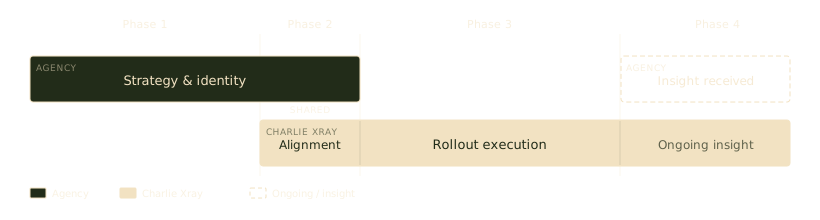
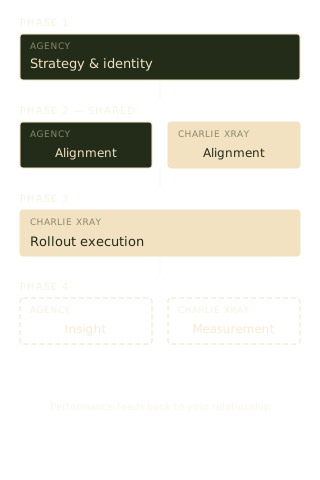
Charlie Xray joins before rollout begins, takes operational ownership of execution, and feeds real-world performance back into your client relationship. Your creative and strategic scope stays entirely yours, but the work now holds up in practice.
The questions worth asking
No. It strengthens it. You remain the strategic and creative lead. Charlie Xray becomes the operational partner responsible for making the rebrand stick, and positions you as the agency that thinks beyond delivery.
Clients experience a more joined-up outcome, they attribute that to you, and the relationship has a reason to continue once the project formally closes. Nothing about the commercial or creative dynamic shifts unless you want it to.
In theory. In practice, the organisations most likely to need this support are the ones growing fast enough that no single person has the bandwidth to own it properly.
Rollout gets absorbed into normal workload, deprioritised when something more urgent appears, and handled reactively rather than systematically. That is not a failure of intent, it’s a structural gap.
Charlie Xray is built specifically for that gap, which is why it gets handled differently when it is owned here.
Cleanly. Strategy, identity, messaging, and creative direction stay entirely with the agency.
Charlie Xray picks up at the operational layer — governance, enablement, asset rollout, QA, and adoption. There is an overlap during pre-rollout alignment, and that handover is deliberately structured so nothing falls between the two.
In practice, most agencies find the boundary easier to hold than they expected, because the work is genuinely different in nature.
That depends on how you want to structure it. Some agencies introduce Charlie Xray directly as a named partner. Others embed the engagement within their own offer.
Either way, the conversation starts with understanding your project and your client relationship, not with a fixed model. If it is a fit, the structure follows from that.
Because rollout is where agency control typically drops off. Once the project is delivered, attention shifts to the next piece of work, and the structure needed to manage execution across an entire organisation is no longer in place. This isn’t a capability issue. It’s a bandwidth and ownership issue. Rollout requires ongoing coordination across teams, systems, and deadlines, and without someone responsible for holding that together, consistency starts to slip. Bringing in a rollout partner keeps that phase controlled without pulling your team into operational work that sits outside your core focus.