
BrandOps Consultancy
BrandOps Consultancy

AI can follow your brand guidelines perfectly and still get your brand completely wrong. Here’s how unchecked AI content can accelerate brand drift, and why the damage often goes unnoticed.
Someone in your business needs a poster. They’ve got an AI design tool, the logo, brand colours and a deadline that was probably yesterday. They upload the guidelines, write a prompt and a few minutes later they’ve got something rather impressive.
The logo’s correct. The colours are right. The typography looks familiar. Even the layout looks professionally designed. Brilliant. That’s another job off the list.
Except the headline sounds nothing like your business. The imagery feels like it belongs to a completely different company. The whole thing has acquired a personality nobody asked for, and the carefully considered positioning you’ve spent years developing has apparently taken the afternoon off.
It’s on-brand, technically. But it isn’t your brand.
You can follow the visual rules and still lose the brand.
Welcome to one of the less obvious problems with AI-generated content: you can follow the visual rules and still lose the brand.
What is AI brand drift? AI brand drift occurs when AI-generated content moves away from a brand’s intended positioning, personality or identity. It can happen even when the content follows approved visual guidelines, and the risk grows as inconsistent work spreads across teams and channels.
Brand drift isn’t new. It happens when the way a business presents itself gradually moves away from its intended position. AI simply makes that process faster, easier and considerably harder to control.
It happens when sales teams improvise their own messaging, agencies interpret guidelines differently, regional teams adapt campaigns or people simply use whatever assets they can find. Usually, no one’s deliberately trying to undermine the brand. They’re just trying to get something done.
AI makes all of this considerably easier.
Previously, creating a campaign, sales presentation or set of promotional materials usually involved someone with at least a passing understanding of the brand. There might have been a brief, a designer, an agency or somebody asking whether the work actually made sense.
Now, anyone with a prompt can produce a reasonably convincing campaign in minutes. They can generate twenty variations, adapt them for different audiences and turn one slightly questionable idea into an entire collection of marketing assets.
The efficiency is extraordinary. The potential for inconsistency is equally impressive.
And because the output often looks polished, the problems are much easier to miss.
This is where conventional brand guidelines can fall short, particularly when they’re being interpreted by AI.
A logo, colour palette and typeface are relatively straightforward instructions. Even a tone of voice can be approximated with enough examples. But a brand isn’t simply a collection of approved ingredients.
It’s a set of deliberate choices about how a business wants to be understood, recognised and remembered. Its positioning, personality, distinctiveness and the expectations it creates all influence whether something is genuinely on-brand.
Imagine a premium financial services company whose identity is built around reassurance, expertise and quiet confidence. Someone asks AI to produce an exciting promotional campaign using its brand assets.
The result is visually immaculate. Unfortunately, it also features a massive discount-style graphic, an urgent call to action and a headline that sounds like someone selling double glazing on a bank holiday weekend.
Nothing is necessarily wrong with the logo. Everything is wrong with the impression.
That’s the problem with treating brand consistency as a design compliance exercise. AI can reproduce the visual identity without understanding the judgement behind it.
A logo can make something identifiable. It doesn’t automatically make it representative of your brand.
Charlie Xray’s 5 Stages of Brand Drift is a diagnostic framework we developed to understand where brand misalignment is happening, how far it has spread and when it starts creating wider business problems.
The model describes five zones of exposure: Deviation, Fragmentation, Dilution, Confusion and Erosion. They’re not necessarily a linear progression, and one badly designed poster isn’t going to destroy your brand overnight.
But AI changes how quickly a relatively small problem can become a much bigger one.
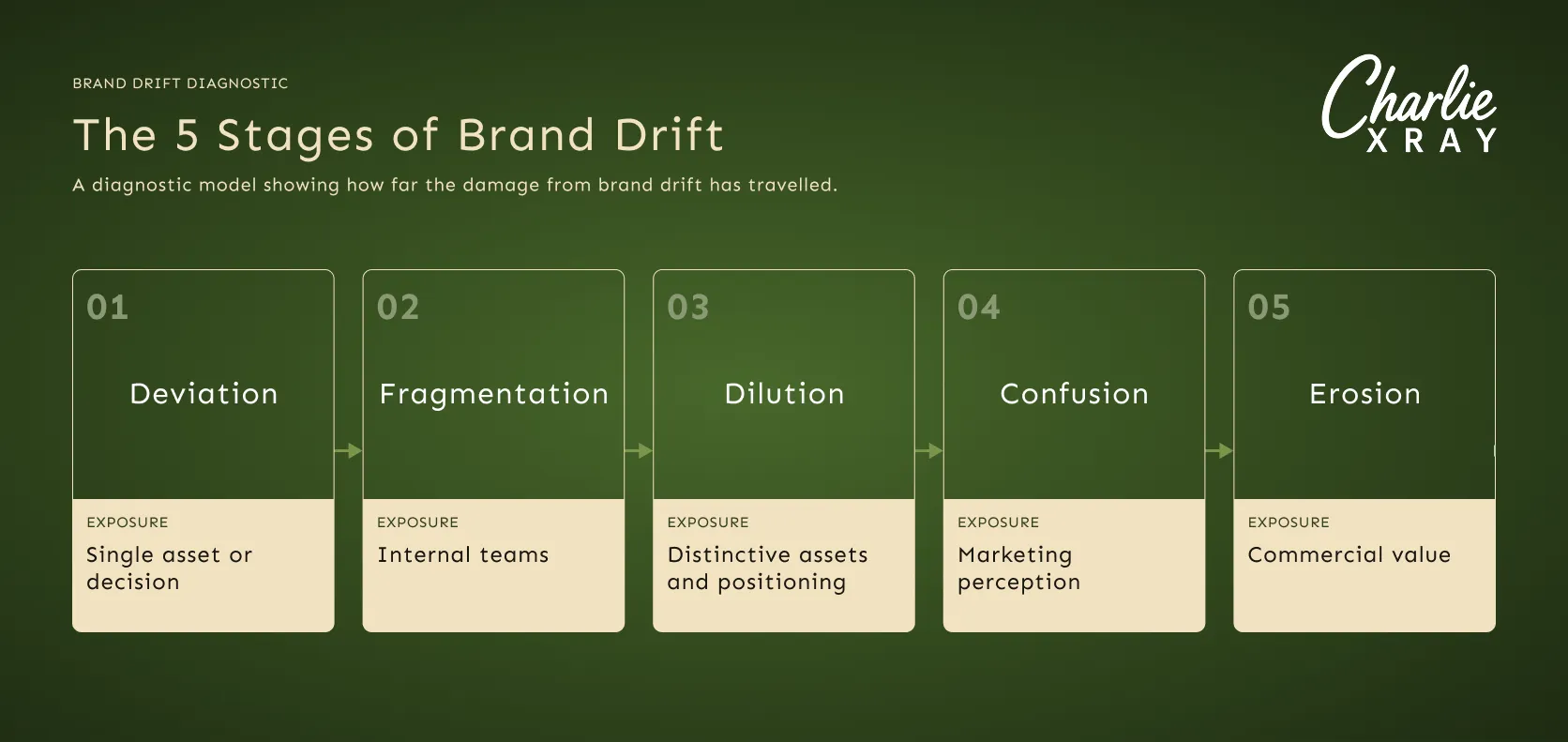
Someone generates that poster. It uses the right assets, but the imagery, tone or message doesn’t reflect the brand. It gets published because it looks professional and nobody spots the problem.
At this point, the damage is relatively contained. It’s one asset, one decision or one touchpoint. But it demonstrates that your existing brand controls aren’t catching everything.
Now imagine sales, marketing, HR and regional teams all using different AI tools, prompts and reference materials. They’re producing presentations, job adverts, social posts and campaigns, each with a slightly different interpretation of the brand.
Individually, everything might look acceptable. Collectively, the business is developing several competing personalities. Nobody has necessarily broken the rules, but nobody is working from quite the same understanding either.
This is where generative AI presents a particularly interesting risk.
Without sufficiently specific direction, AI often defaults to familiar imagery, conventional design choices and predictable marketing language. Distinctive brand characteristics can gradually be replaced by whatever looks plausible and professional.
Your sharp, recognisable tone becomes pleasantly corporate. Your unusual creative style becomes something safer. Your carefully chosen positioning becomes a collection of phrases about innovation, excellence and unlocking potential.
The brand hasn’t disappeared. It’s just becoming a little less interesting, and a lot more like everyone else.
That’s what makes AI-driven dilution particularly difficult to spot. The brand assets can remain perfectly intact while the decisions that made the brand distinctive gradually disappear.
Eventually, those internal differences reach the outside world.
A prospect sees an understated website, an aggressively promotional social advert and a sales presentation that seems to be describing a different business. The individual pieces may be competent, but together they create a confused picture.
Customers don’t analyse this as brand drift. They simply become less certain about who you are, what you offer and why they should choose you.
If inconsistency and confusion persist, brand equity can weaken. Recognition becomes harder to build, differentiation less convincing and marketing less effective.
You may find yourself spending more to communicate a proposition that used to be clearer. Sales teams might need to do more explaining. Customers may have fewer reasons to choose you beyond price.
It’s not inevitable that AI-generated content will cause these problems, and proving a direct commercial effect requires proper measurement. But the potential progression from a seemingly harmless creative decision to a wider business problem is precisely why early-stage brand drift deserves attention.
The important question isn’t simply whether something is off-brand. It’s how far that misalignment has travelled.
Explore Charlie Xray’s full 5 Stages of Brand Drift framework →
The obvious response is to give AI better instructions. Upload the guidelines, create a set of approved prompts, restrict which tools people can use and perhaps insist everything goes through marketing for approval.
Some of that will help. But it’s not a complete answer.
If your guidelines don’t explain the thinking behind the brand, AI has little chance of interpreting it properly. And if different teams don’t share a clear understanding of that thinking, giving them better technology won’t suddenly create alignment.
There’s also a risk of solving the problem by introducing so much approval and bureaucracy that nobody can get anything done. That rather defeats the point of using AI in the first place.
The better approach is to make brand decisions easier to get right, with clear foundations, practical guidance, useful examples and quality checks proportionate to the risk.
You don’t need a committee to approve every AI-generated image or social post. But you do need a way of judging the work beyond whether it looks vaguely familiar.
Before publishing, ask:
If the answer to any of these is no, it deserves another look. And if the same problems keep appearing, you’re probably dealing with something more significant than a few poor prompts.
That’s where a structured brand evaluation process becomes valuable. Rather than relying on somebody’s instinct that something doesn’t feel quite right, you can assess work against defined standards and identify recurring patterns before they spread.
AI creates a genuine opportunity for businesses to produce more, move faster and make better use of limited resources. The answer isn’t to stop people using it.
But the freedom to create needs to be matched by the ability to evaluate what gets created.
That’s one of the reasons we’re pioneering BrandOps at Charlie Xray. It treats brand consistency as an operational discipline, connecting the brand’s foundations with governance, enablement, quality assurance and ongoing measurement.
In practice, that means giving people and AI tools the right context, establishing sensible boundaries and identifying problems while they’re still manageable. Not becoming the brand police, and certainly not insisting somebody senior personally approves every PowerPoint slide.
The objective is to help the business move faster without gradually losing the things that make its brand valuable.
AI is making content production faster, cheaper and more accessible. For many businesses, that’s a considerable advantage.
But more content doesn’t automatically mean a stronger brand. If every new asset introduces a slightly different interpretation of who you are, you could be working remarkably efficiently towards the wrong outcome.
The real challenge isn’t getting AI to use your logo correctly. It’s making sure the work reinforces the brand you’re trying to build.
Because if you’re producing more material, more quickly, without checking whether it’s right, you might not be scaling your brand at all. You might just be scaling the drift.
You might not be scaling your brand at all. You might just be scaling the drift.
Charlies Xray’s 5 Stages of Brand Drift offers a practical way to understand whether misalignment is contained within individual assets or spreading into the wider business.
At Charlie Xray, we help businesses identify brand drift and put the operational systems in place to protect consistency as they grow.