
BrandOps Consultancy
BrandOps Consultancy

Earlier this year, I spoke to an agency that had just delivered a six-month rebrand. The kind of project that takes real strategic thinking and doesn’t happen quickly. The client was happy at handover. The identity was tight and the strategy held together.
Then the client rolled it out.
The first campaigns went live and something was already off. Not catastrophically but enough that everyone at the agency felt it. The intent behind the identity hadn’t survived the handover. The brand that showed up in the world wasn’t quite the brand that had been designed.
Nobody was at fault. The agency had done their job properly. The client’s teams were doing theirs. But somewhere between delivery and execution, control had slipped, and there was no structure in place to catch it.
That feeling is more common than agencies tend to admit.
Every rebrand has phases with clear ownership. Agencies are built for those. The brief gets written, the work gets made, the presentation lands well.
What happens next is less defined.
The brand moves out of the project environment and into a business that has to live with it daily. The people now responsible for applying it weren’t in the room when the decisions were made. They’re under pressure to produce content, launch campaigns, update collateral. They interpret, adapt, and improvise, because nobody has given them the operational infrastructure to do anything else.
Assets get recreated when the originals don’t fit a format. Legacy materials stay in circulation longer than they should. Visual and verbal codes shift by small degrees across different teams and channels.
Over time, the brand that was signed off and the brand that’s showing up in the world become different things. And nobody is quite sure whose job it is to fix it.
This matters beyond the obvious consistency problem.
Six months after handover, the case study gets harder to write. The brand in the wild doesn’t match the brand in the deck. The client, who was genuinely delighted at delivery, carries a vague sense that something isn’t landing, without being able to trace it back to execution rather than thinking.
That erodes something important. Not the relationship necessarily, but the clarity of what the agency contributed. The work was right. The strategy was sound. The brief was answered. But the proof is getting diluted in real time, and there is no mechanism to stop it.
For an agency, that is the real cost. Not the client’s inconsistency problem. Yours.
Most agencies aren’t set up to manage what comes after delivery, and they shouldn’t have to be. The project model is built for a defined scope with a clear end point. Rollout is ongoing, operational, and cuts across teams and systems in ways that don’t fit neatly into a project brief.
Clients aren’t set up for it either. Responsibility spreads across functions. Priorities compete. Without a named owner, the brand gets maintained in fragments rather than managed as a whole.
What that phase needs is an operational layer. Governance, enablement, and quality control across real-world execution. The work that sits between the creative output and the teams applying it, making sure the brand that was designed is the brand that shows up.
That’s what the Charlie Xray Rebrand Rollout Partner model provides.
The agency retains everything it should. Strategy, creative direction, client relationship.
Charlie Xray takes the execution layer. We make sure the foundations are accessible and usable, that teams know how to apply the brand properly, and that drift gets caught before it builds. We track how the brand is being applied and feed performance data back into the client relationship.
No scope overlap. No ambiguity about who owns what.
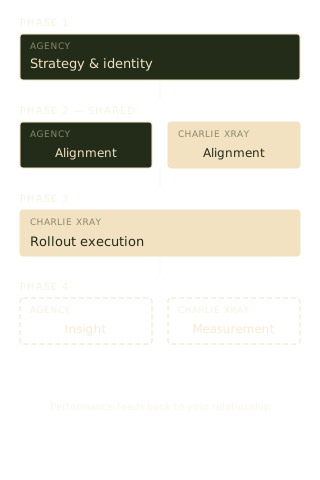
What there is, is evidence. Real data on how the brand is performing in execution, which is a much stronger position when the next strategic conversation comes around.
When rollout is handled properly, something shifts.
There’s always something worth talking about. Brand performance is being tracked. Execution is being measured against the original thinking. Adjustments get made based on what’s actually happening, not assumption.
That’s a different foundation for ongoing work than waiting for the next brief to come in. It keeps you close to the decisions that matter, because you’re working from live insight rather than reconnecting after drift has already set in.
The agencies that build the strongest long-term relationships aren’t necessarily the busiest ones. They’re the ones who stay relevant between projects.
Rebrand rollout is the phase after the creative work is delivered, when the brand moves into the business and gets applied across teams, channels, and day-to-day operations.
It goes wrong when there’s no operational structure to support it. Internal teams weren’t part of the original project. They’re working under pressure and without clear guidance, so they interpret and adapt. Multiply that across a whole organisation over several months, and the brand shifts.
In most businesses, nobody owns it clearly. Marketing, brand, product, and ops teams all touch the brand in different ways.
Without a named owner and a governance structure, consistency depends on goodwill and memory rather than systems. That’s why drift is so common, and why it’s rarely caught until it’s already built up.
The agencies that stay most relevant after delivery are the ones with something to bring back to the table. Performance data, execution insight, evidence of how the brand is landing. That requires some kind of ongoing involvement in what happens after handover, which the standard project model doesn’t accommodate.
A rollout partner takes operational ownership of the execution phase. That means making sure brand foundations are accessible and usable across teams, building governance and enablement so people can apply the brand properly, tracking consistency across live touchpoints, and catching drift before it builds.
The creative agency retains strategy and direction. The rollout partner owns what happens next.
Through regular audits of live assets across channels, tracking how visual and verbal codes are being applied against the defined brand foundations.
A Brand Signal Scan is a practical starting point, identifying where execution is aligned and where it’s drifting, so corrections can be made before the gap becomes significant.
You already understand what this solves.
The question is whether there’s a better way to protect the work once it leaves your hands, and whether staying close to the client after delivery is worth more than waiting for the next brief.
See how the Rebrand Rollout Partner model works for agencies →